
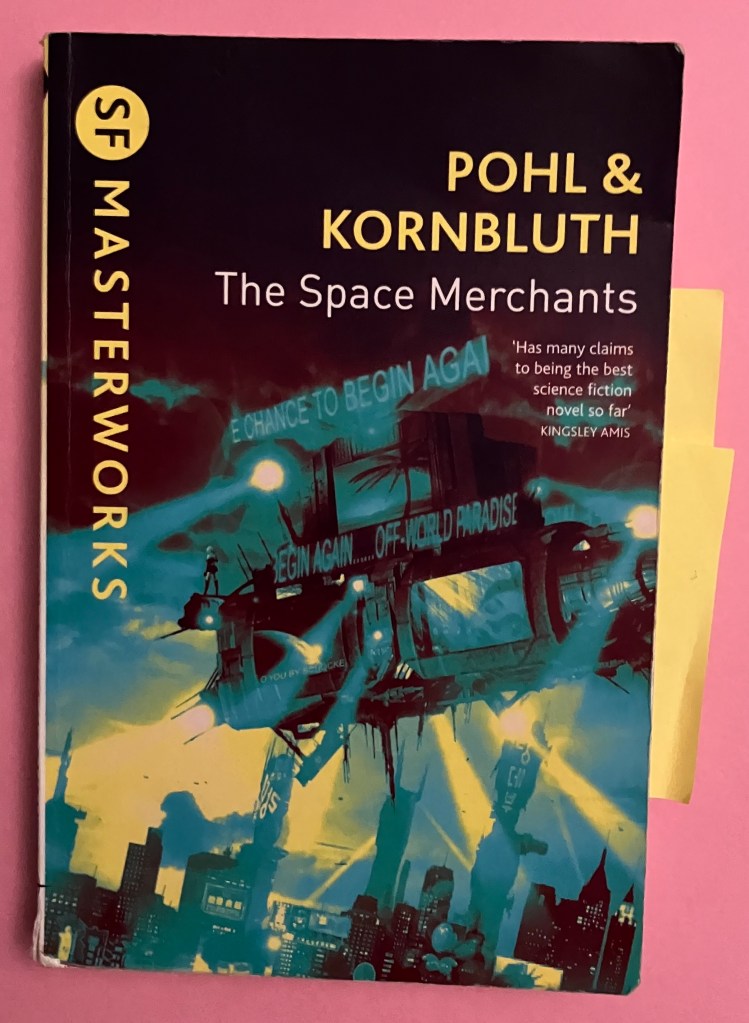
This horribly prophetic science fiction novel was written in 1952 by Frederik Pohl and C. M. Kornbluth. America was applying its massive economic potential to consumer production after WWII and the Korean War, generating an economic momentum that would change the country forever. The novel projects that momentum into a future where capitalism is a ravening monster, an insane Moloch eating its consumers. As a religion, it also partakes of the anti-communist hysteria of the McCarthy era.
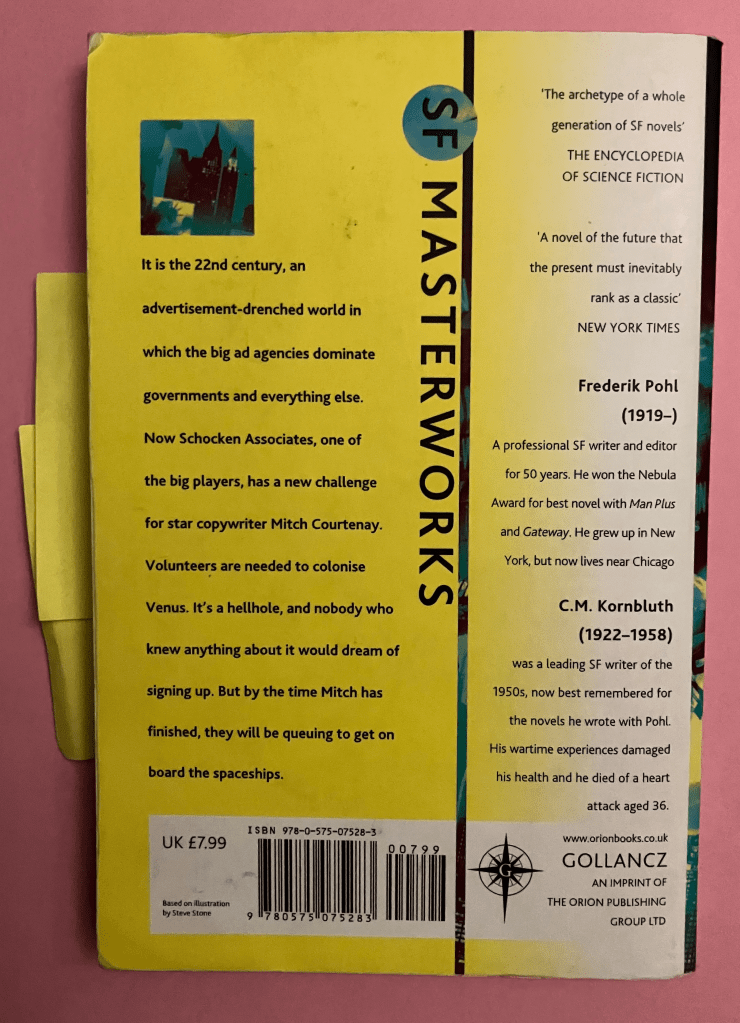
The protagonist, Mitchell Courtenay, is a ‘star class copysmith’ working for Fowler Schocken, one of the great advertising agencies that sells the American dream. The government is in its pocket and businesses rely on its expertese to sell their products. Fowler Schocken’s bitter enemy is Universal, almost as successful but considered low class. The latest campaign, which they stole from Universal, is to sell mass emigration to Venus, an uninhabitable planet they hope to terraform sufficiently for human life. There’s a rocket ship under construction and all it needs are gullible passengers. Does this sound familiar? Mitchell Courtenay is the lucky guy chosen to head the project. Of course, a major part of his brief is to make sure that the colonists continue to love and consume all the brands they’ve been brainwashed into loving on Earth.
In fact there is a very good reason why people have to leave the Earth. Rampant capitalism and overpopulation has so polluted the environment that soot plugs are necessary to survive outside hermetically sealed buildings, where people shelter from the acid rain. Water is rationed. All the oil has gone. Weirdly, sustainable energy – solar power – is standard because there’s nothing else. Instead of cars there are rickshaws for the wealthy. Even a star class copysmith can’t afford anything bigger than two small rooms with fold-down furniture, and the Fowler Schocken boardroom measures a princely 10′ by 12′ . In a word, enshittification.
Inevitably, there is a reversal of fortune and Mitch slowly comes to understand the life of the indentured workers at the bottom of the corporate heap. Despite this radical critique of capitalism, the novel is quite old-fashioned in its portrayal of gender roles. Even that is prescient, given the Trump regime’s rollback to the 1950s. We have a classic romantic resolution, though his love interest, ex-wife Kathy, is not all she seems.
The Space Merchants is surprisingly contemporary, ironically eviscerating end stage capitalism through Mitchell’s fervent, fundamentalist belief in its rightness. Fowler Schocken himself is given to telling stories about the triumph of his profession which are a masterclass in manipulation. Pohl and Kornbluth probably never envisaged anything like the techbros, so in this world it’s the ad agency copysmiths putting a chokehold on the planet and human rights.
Which begs the question, who is writing now about Earth’s future under the techbros? Let me know in the comments.

 The Belated Leap