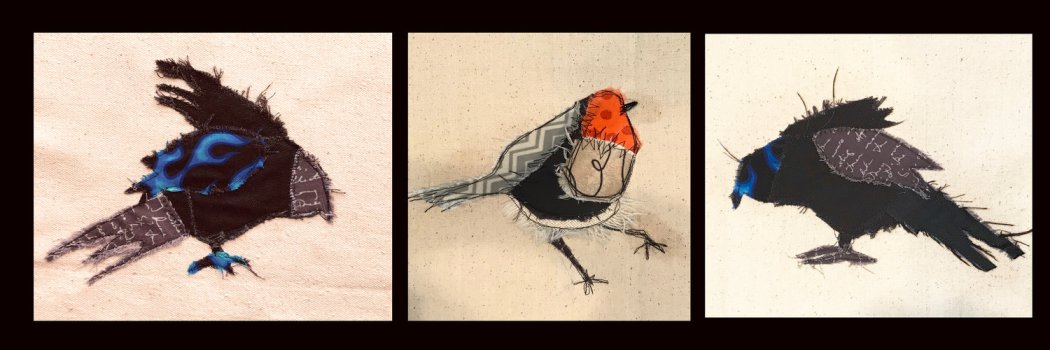
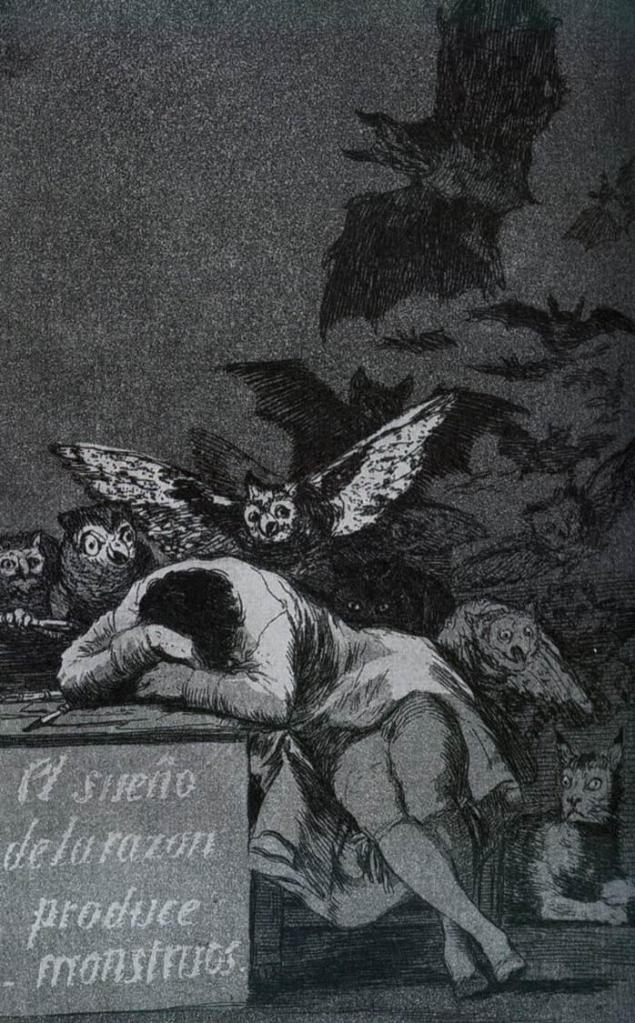
The sleep of reason produces monsters.
Always remember that the famous Goya quote has at least two meanings. Do the monsters arise because reason is asleep, or are they dreamed up by reason in an attempt to control the world?
Thirty years ago, I became an atheist. I remember it well. I was walking along a Seattle street when, quite unexpectedly, the gods flapped away from my shoulders in search of a more comfortable roost. Up to that point I had been an Anglican for a short time as a pious schoolboy, metaphysical speculator extraordinaire as a hippy, Soka Gakkai Buddhist for 20 years, and, while drying out from the preceding, enjoyed a sampler menu of all the pagan groups in Seattle. Of this last, the OTO was the tastiest: the Aleister Crowley crowd, the Great Beast whose number is 666, the man who scandalised Europe and America in the first half of the 20th century. Or, as I like to think of him, Uncle Aleister. We had Gnostic Mass every month in a rented Freemason Lodge, all very High Church with plush velvet fittings and a lot of impressive ritual. In addition, I was fascinated by mythology and the stories religions tell. I even have a GCE in Religious Knowledge, and like Bertie Wooster, I’m very proud of that accomplishment.
So, there I was, free from all that, and wondering what to do next. The obvious thing was check out the Richard Dawkins online forum, prepared for a bracing feast of reason. Alas! it was not to be. I found instead levels of fundamentalist bigotry and irrationality, the like of which probably hasn’t been seen since the Inquisition. To the Dawkinsites, religion is inherently evil, all religious groups are monolithic blocks of believers absolutely wedded to the worst doctrines anyone can ascribe to them, and only atheists are rational, ethical and intelligent. Straw men all. I turned my back on them as well and contented myself with simply not believing, while still being fascinated by religious belief.
Moving on 30 years, and here I am in Scotland, doing an Arts and Humanities degree with the Open University. The module is organised around different themes, each of which is studied through one or more academic disciplines, like History, Literature, Classical Studies, and so on. One theme which brought me up short was Mary, mother of God. I discovered that in Religious Studies, dogma is only a small part of the subject, and you don’t have to believe it to study it. The rest is about the history, institutions context, practices, objects, and above all the stories that believers tell about their faith to create ‘life-worlds’. The sociology, you might say. Armed with this caveat, I proceeded warily, only to be halted in my tracks again by Our Lady of the Underpass, a Marian apparition in Chicago, created through the leaching of salt stains in an underpass. The module treated this perfectly seriously but the unregenerate Dawkinsite remnant, like an irritating piece of grit inside me, kept crying out, “It’s a salt stain!” So I hurried through the materials and didn’t answer that question in the essay.
That was last autumn. This winter we had Christianity and its material culture, focusing on Canterbury Cathedral, Dunfermline Abbey in Scotland, and John Wesley’s New Room in Bristol. it looks at material culture, buildings for example, and how they interact with beliefs, practices and events to create meaning. This was my way into religion as a subject, guided by David Morgan, an art historian used in the chapter. He says:
As a field of inquiry, material culture assumes that meaning does not inhere in things, but is activated by them. Meaning is a complex process of interaction in which people, objects, environments, histories, words, and ideas take part.
You might say it was a materialist epiphany that allowed me to think about religious belief without that slightly icky feeling that I’m letting the atheist side down. So I answered the essay question on Canterbury and enjoyed the immersion. It might be a foetid heap of dingo’s kidneys for all I know, since it hasn’t been marked yet, but I’m happy to find myself in a subject area I enjoy thinking about and might do more work in. We were asked to read an online excerpt from a book about pilgrimages which I found so interesting that I bought the book online.
Pilgrimage: A Very Short Introduction, by Ian Reader, is a brief cross-cultural overview of pilgrimages around the world, why people go, how they do it, what they get up to, full of quirky details. Very enjoyable. As the News of the World used to say of itself, all human life is here. No absurd Dawkinsite straw men, just people being themselves. This was another epiphany. Most people go on pilgrimages for a huge variety of reasons – religious and secular – without realising it. I once traveled from Seattle to Dundee in order to touch with my own hands the manuscripts of William McGonagall, Scotland’s worst poet and one of my heroes. I can now say I’ve been blessed by the spirit of bad poetry. They’re held in Dundee Central Library which was weirdly at the top of a shopping mall. I also followed in the great man’s footsteps around his familiar haunts in the city. At the same time I combined it with a holiday in the Lake District, where I once lived. Pilgrims combine all of these elements and many more.
I feel like a changed man, as if I had been on a pilgrimage of the mind. I am Legion, chock full of ideas. Where will I go next?

 The Belated Leap